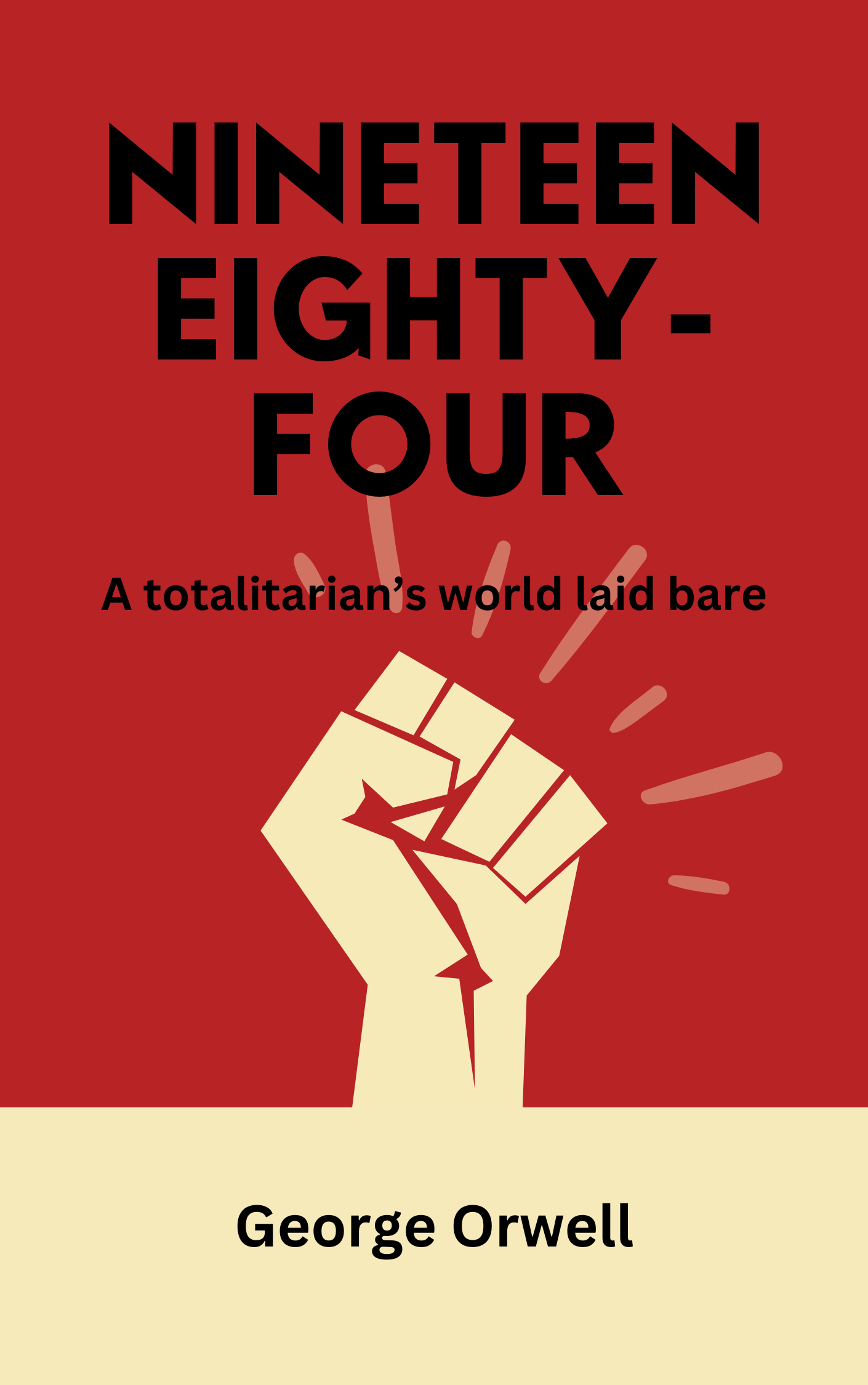
A dystopian masterpiece that serves as a compelling warning for the human race. Step into this haunting world where the all-powerful Party, under the watchful eye of it’s leader, the Big Brother, controls a society filled with conformity, deception, and twisted truths. As we leafed through the pages of this timeless book, a thought occurred to us: "The best books are those that tell you what you know already." These words echoed in our minds as we delved into George...
Total surveillance: Omnipresent, scrutinizing gaze
In the dystopian future of 1984, the world is divided into three superstates – Oceania, Eurasia and Eastasia. The three giants are drawn in a stalemate of power struggle.For Winston Smith, it's April 4, 1984—or is it? He has lost track of time a while back, and his memories have been tricky ever since Ingsoc, or English Socialism, a ruling party promoting totalitarianism in the guise of socialism, took over in Oceania, a superstate made up of the English-speaking nations...
Lies, propaganda, everywhere!
Winston toils tirelessly at Minitrue, the Ministry of Truth, a puppeteer manipulating the threads of news, entertainment, education, and the arts. His duty is not just rewriting history but reimagining it entirely to align with the Party's ever-shifting narrative. In the aftermath of his revisions, he sends the discarded truth into the memory hole—a fiery abyss where inconvenient facts vanish from the collective human consciousness – burned to ashes.Yet, the past has a stubborn way of resurfacing. In the late...
Existence of life within the boundaries of Oceania
In a striking irony, the Party portrays Oceania as a utopia, a land of abundance. However, the stark truth reveals a life marred by scarcity and deception. Despite the Party's vision of an ideal society, its members, short and ugly, endure a meagre existence in dilapidated homes, surviving on slimy stews. Rationed essentials challenge the proclaimed plenty.Daily life unfolds with rigid control. The "Two Minutes Hate" program, seemingly fostering unity, targets Emmanuel Goldstein who once was a revolutionary hero and...
Seeking the past
Winston clings to the hope found in the proles, the vast majority of Oceania's population. Faraway from the Party's boastful claims of liberating them from poverty, the bitter truth reveals their continued hardship. They drown the pain from hard labour in lottery, movies, football and beer. To see their lives with his own eyes, he visited one of their neighborhoods. To him, the people appeared dull but not inhuman as claimed by the Party. Defying the Party's disdain for the...
Love blossoming in the forbidden realm
One day, the girl - Julia slips Winston a note that says, "I love you." They risk their lives to meet in the woods away from microphones and telescreens. Julia admits she can tell Winston is against the Party just by looking at him. Winston appreciates her honesty about sleeping with many Party members, seeing it as a rebellion he supports. He believes their connection, driven by an animalistic spirit, will eventually undermine the Party's power. To Winston, being with...
The dawn of truth’s realization
During the peak of Hate Week's climax, amidst the frenzied masses, the startling news breaks: Eastasia, once an ally, is now the enemy, and Eurasia, the former foe, is now an ally. The crowd, seemingly undisturbed, seamlessly shifts their hatred focus. This sudden twist throws the employees at Ministry of truth into a colossal task – rewriting all articles, history books, pamphlets, and posters to align with the new narrative that Oceania has perennially been at war with Eastasia and...
Will two plus two be equal to five?
In the cold cell of the Ministry of Love, all that Winston can think about is when he'll finally get something to eat, what the heck happened to Julia, and whether O'Brien will actually come through for him. It's like a revolving door of tortured souls being brought in and out in the brightly lit rooms as guards shuffle them around. Amid relentless blows, Winston's consciousness fades in and out. All this torture was witnessed by O’ Brien - Winston’s...
Fostering propaganda through brainwashing
In the twisted tale of deceit and lies, Winston admires O’Brien, who, as it turns out, wrote the book that was thought by everyone to be Goldstein’s work. O’Brien, despite seeing through everything, genuinely embraces the Party’s lies. According to the Party, the laws of Nature are fabrications, the sun orbits the Earth, and even gravity and matter are subject to the omnipotent Party. Unlike old Utopians who vouched for true Socialism, the Party seeks power for its own sake,...
Chapter 11
Details coming soon.
Summary
The Machinery of Oppression: Orwell paints a chilling portrait of Oceania, a totalitarian super state governed by the omnipresent Big Brother. Its oppressive machinery relies heavily on surveillance, with telescreens monitoring every move and microphones catching every whisper. The Thought Police enforce absolute conformity, ruthlessly eliminating any divergence from the Party's dictated reality. Information is tightly controlled through the Ministry of Truth, which rewrites history and manufactures news to serve the regime's agenda. Language itself is warped through Newspeak, a...
More knowledge in less time
The Art of Community
Get the key ideas from nonfiction bestsellers in minutes, not hours.
Find your next read
Get book lists curated by experts and personalized recommendations.
Shortcasts
We’ve teamed up with podcast creators to bring you key insights from podcasts.
About the Author
George Orwell is one of England's most famous writers and social commentators. Among his works are the classic political satire Animal Farm and the dystopian nightmare vision Nineteen Eighty-Four. Orwell was also a prolific essayist, and it is for these works that he was perhaps best known during his lifetime. They include Why I Write and Politics and the English Language. His writing is at once insightful, poignant and entertaining, and continues to be read widely all over the world.
Eric Arthur Blair (George Orwell) was born in 1903 in India, where his father worked for the Civil Service. The family moved to England in 1907 and in 1917 Orwell entered Eton, where he contributed regularly to the various college magazines. From 1922 to 1927 he served with the Indian Imperial Police in Burma, an experience that inspired his first novel, Burmese Days (1934). Several years of poverty followed. He lived in Paris for two years before returning to England, where he worked successively as a private tutor, schoolteacher and bookshop assistant, and contributed reviews and articles to a number of periodicals. Down and Out in Paris and London was published in 1933. In 1936 he was commissioned by Victor Gollancz to visit areas of mass unemployment in Lancashire and Yorkshire, and The Road to Wigan Pier (1937) is a powerful description of the poverty he saw there.
At the end of 1936 Orwell went to Spain to fight for the Republicans and was wounded. Homage to Catalonia is his account of the civil war. He was admitted to a sanatorium in 1938 and from then on was never fully fit. He spent six months in Morocco and there wrote Coming Up for Air. During the Second World War he served in the Home Guard and worked for the BBC Eastern Service from 1941 to 1943. As literary editor of the Tribune he contributed a regular page of political and literary commentary, and he also wrote for the Observer and later for the Manchester Evening News. His unique political allegory, Animal Farm was published in 1945, and it was this novel, together with Nineteen Eighty-Four (1949), which brought him world-wide fame.
It was around this time that Orwell's unique political allegory Animal Farm (1945) was published. The novel is recognised as a classic of modern political satire and is simultaneously an engaging story and convincing allegory. It was this novel, together with Nineteen Eighty-Four (1949), which finally brought him world-wide fame. Nineteen Eighty-Four's ominous depiction of a repressive, totalitarian regime shocked contemporary readers, but ensures that the book remains perhaps the preeminent dystopian novel of modern literature.
Orwell's fiercely moral writing has consistently struck a chord with each passing generation. The intense honesty and insight of his essays and non-fiction made Orwell one of the foremost social commentators of his age. Added to this, his ability to construct elaborately imaginative fictional worlds, which he imbued with this acute sense of morality, has undoubtedly assured his contemporary and future relevance.
George Orwell died in London in January 1950.
More on: https://www.amazon.in/stores/author/B000AQ0KKY/about
Thank you for registering with Storise.
Your journey with books and ideas begins now, anytime, anywhere.
You can now use your registered email to log in to the app.























.png)